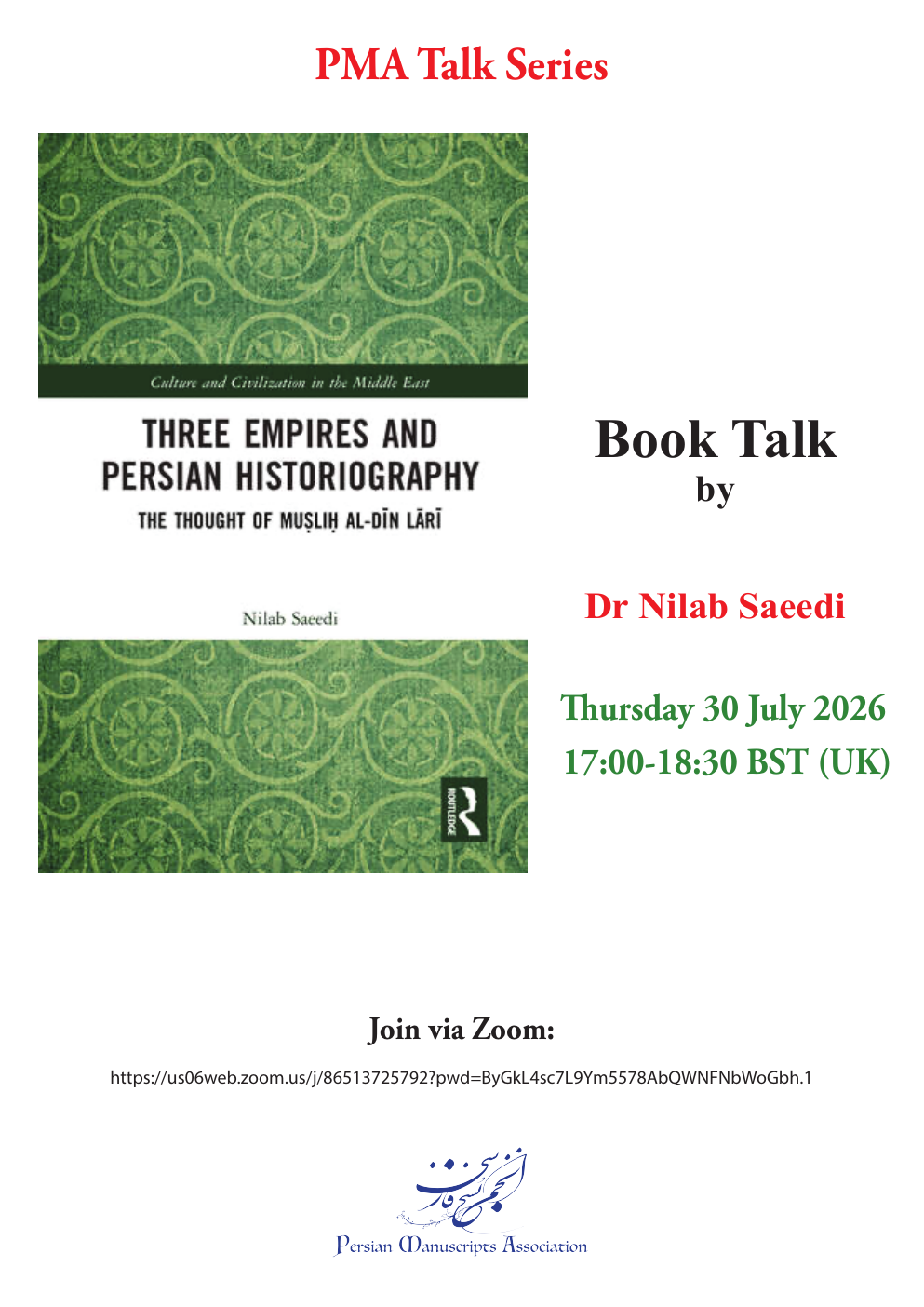
Dr Nilab Saeedi · 30 July 2026, 5–6:30 pm BST · Online
Abstract
This talk presents Three Empires and Persian Historiography: The Thought of Muṣliḥ al-Dīn Lārī, a book nominated by Routledge for the 2026 Morris D. Forkosch Prize for the Best First Book in Intellectual History. It explores the historical thought of the sixteenth-century scholar Muṣliḥ al-Dīn Lārī through his universal chronicle, Mirʾātu’l-Advār wa Mirqātu’l-Akhbār (The Mirror of Epochs and the Staircase of Historical Reports). Written in Persian and completed upon the accession of Sultan Selīm II, the chronicle reflects Lārī’s engagement with the Timurid, Safavid, and Ottoman worlds. The talk examines how Lārī used historiography to address questions of imperial legitimacy, political change, and intellectual authority. By comparing his portrayals of the Safavids, Timurids, and Ottomans, Nilab Saeedi argues that Lārī employed universal history not only to record the past but also to negotiate the shifting political and intellectual landscape of the early modern Islamic world.
About the speaker
Dr Nilab Saeedi is a Research Associate at the Institute of Habsburg and Balkan Studies at the Austrian Academy of Sciences. She received her PhD in History from Ibn Haldun University in Istanbul in 2025, where her dissertation was awarded the Best Doctoral Thesis of the Year. She holds an MA in Turkish Literature and a BA in Linguistics. Her research focuses on early modern Ottoman history, Persian historiography, and Islamic intellectual history. She also serves as a contributing editor for the Journal of the History of Ideas. She will lead her own postdoctoral research project in 2027: “The Ottoman History Bureau: Şehnamecilik (1550–1601)”, funded by the Austrian Science Fund (FWF). Her current work explores Ottoman and Persian historical writing, court historiography, and the intellectual networks that connected the early modern Islamic world.