Dr Mahroo Moosavi · 20 November 2025, 5–6:30 pm UK time
Abstract
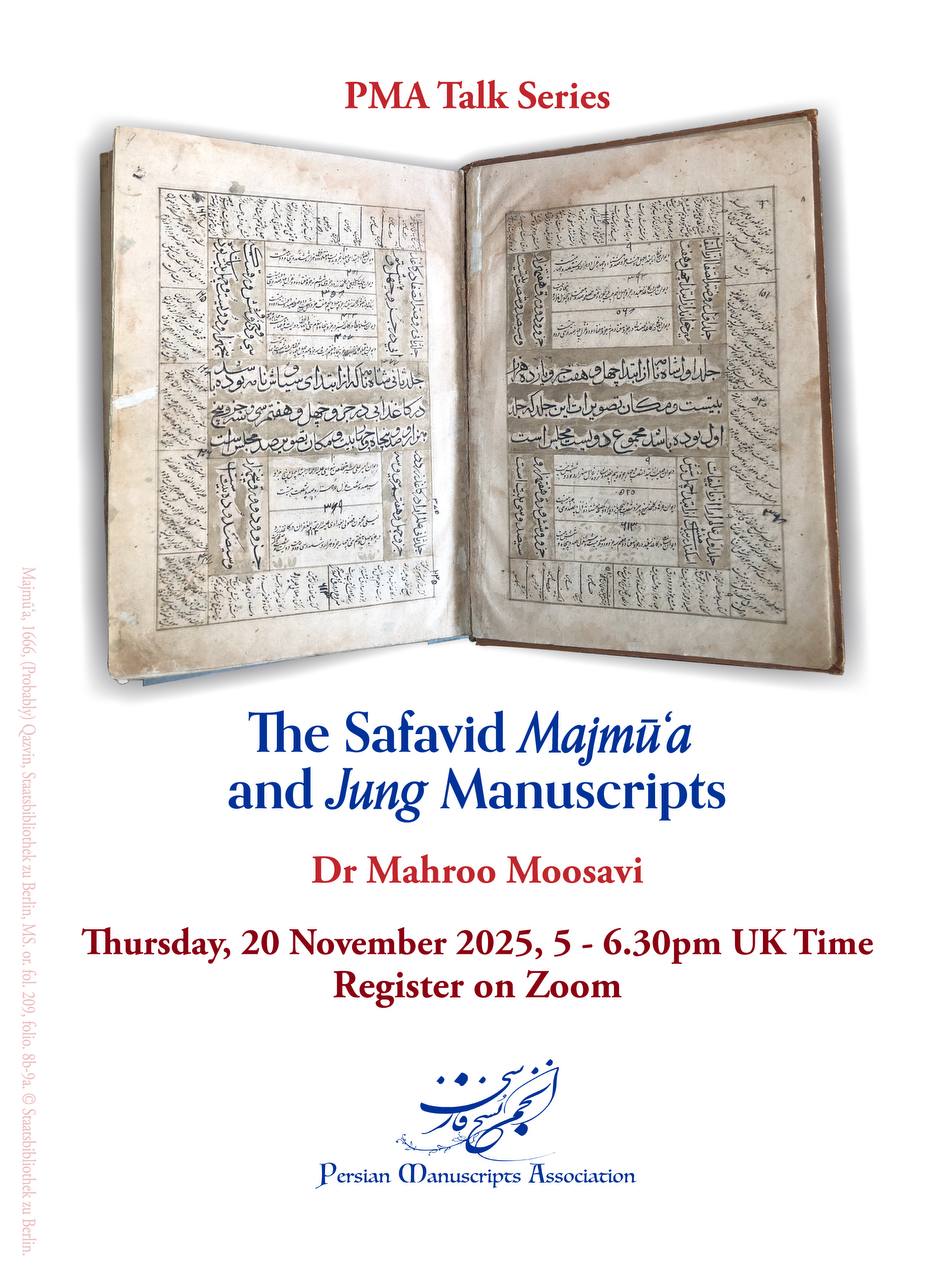
The manuscript collections across the world include many 16th and 17th centuries Persian book compilations (with terms and types such as majmūʿa, jung, Safīna, bayāż, and muraqqaʿ). These books cover a broad range of genres, themes, and titles and compile them in several ways and through different methodologies which are yet to be studied. These genres, themes, and titles include poetry and prose, chancellery or personal epistles, treatise on arts, decrees, religious accounts and prayers, occult texts, poets’ biographies, tales and more.
This talk focusses on a few of such compilations, while considering them not only as containers of historical, literary, and artistic accounts, but more importantly, in many cases, as the carefully tailored, self-managing systems that operate efficiently through an inner logic of their constituent fragments. The talk is particularly concerned with discussing novel methodologies through which these compilations may be approached and analysed and how and under what mechanisms were these texts and images selected, assembled, and curated in such compilations.
About the speaker
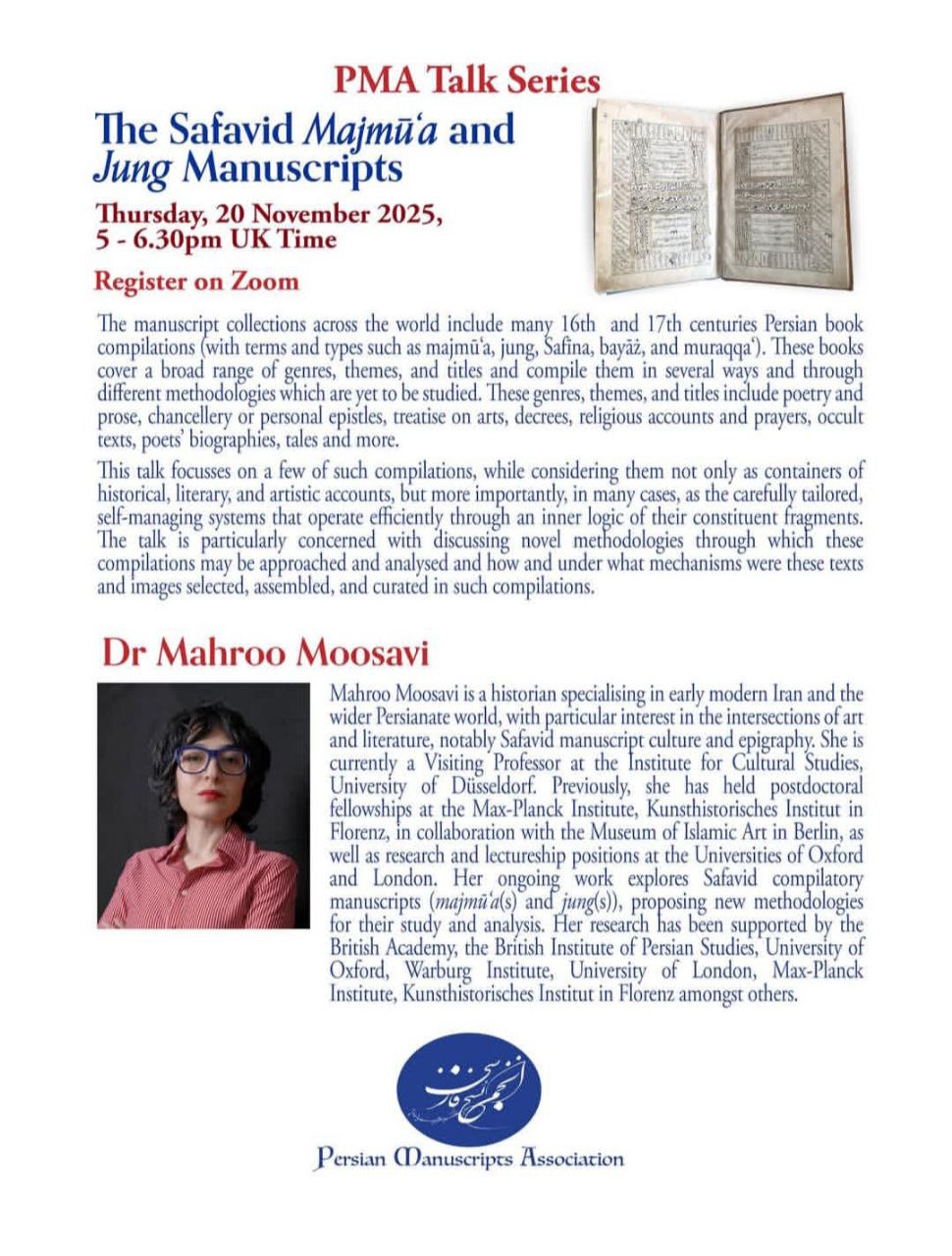
Mahroo Moosavi is a historian specialising in early modern Iran and the wider Persianate world, with particular interest in the intersections of art and literature, notably Safavid manuscript culture and epigraphy. She is currently a Visiting Professor at the Institute for Cultural Studies, University of Düsseldorf. Previously, she has held postdoctoral fellowships at the Max-Planck Institute, Kunsthistorisches Institut in Florenz, in collaboration with the Museum of Islamic Art in Berlin, as well as research and lectureship positions at the Universities of Oxford and London. Her ongoing work explores Safavid compilatory manuscripts (majmūʿa(s) and jung(s)), proposing new methodologies for their study and analysis. Her research has been supported by the British Academy, the British Institute of Persian Studies, University of Oxford, Warburg Institute, University of London, Max-Planck Institute, Kunsthistorisches Institut in Florenz amongst others.