Dr Nourane Ben Azzouna · 11 June 2026, 5 pm BST
Abstract
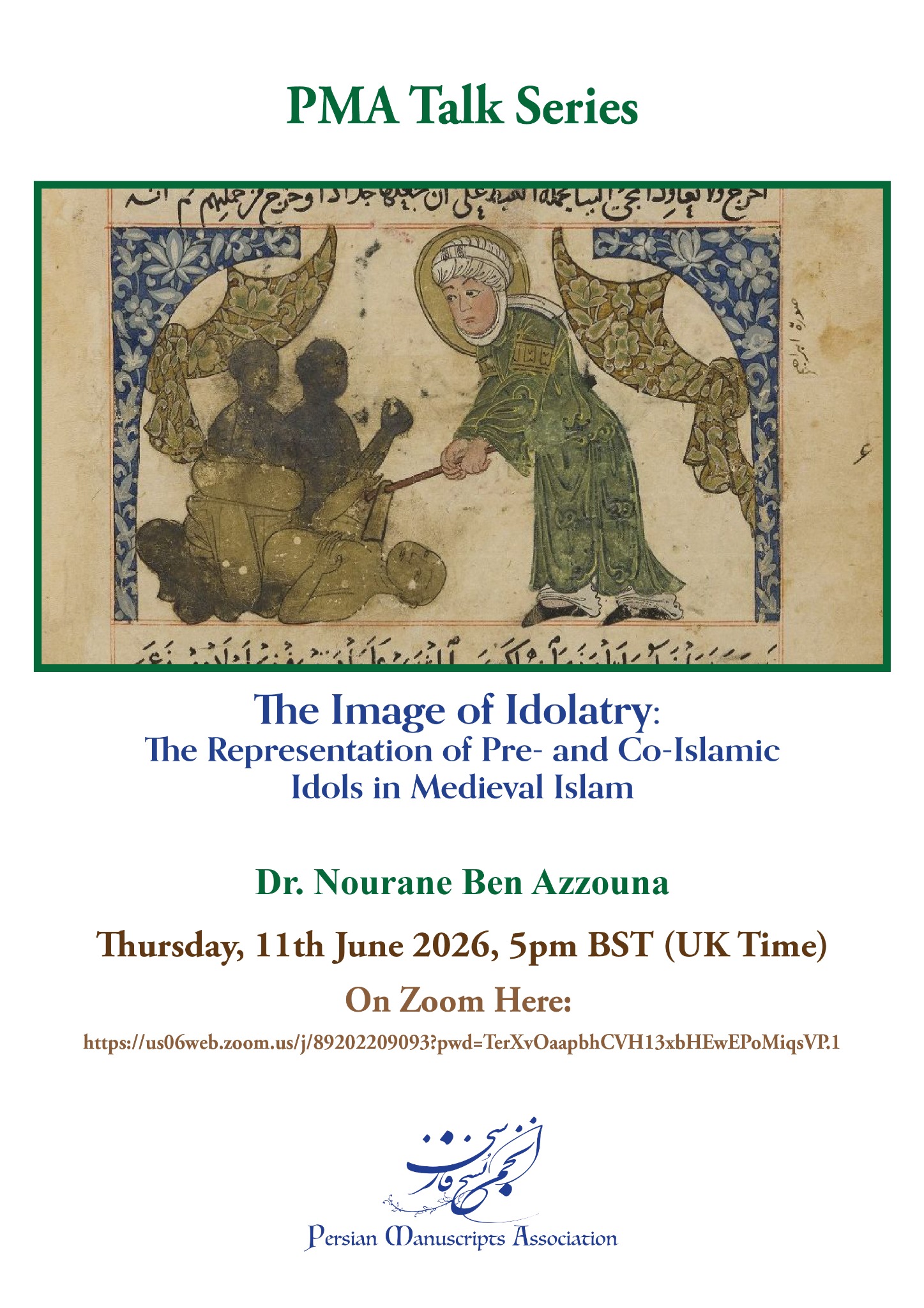
Islam is fundamentally defined by monotheism and divine transcendence, in contrast to polytheism and the immanence of pagan gods in idols, whether iconic or aniconic – the majority of pre-Islamic Arabian idols belonging to the latter category. The destruction of idols even appears to be the equivalent in action of the profession of faith that marks, in words, the conversion of a place, a group of people or an individual to Islam. However, neither the destruction nor even the condemnation of idols was systematic in the medieval Islamic world. Muslims spared, preserved and even adopted, in various ways, many of the “idols” that they encountered in the territories they conquered, from Spain to India and beyond. This presentation will examine the question of the relationship of Muslims to the pre- and co-Islamic “idols” or sacred images that they identified as such in the medieval period. It will reconsider accounts of idol destruction as a topos rather than a systematic reality, and explore how pre- and co-Islamic idols were integrated into the physical and mental landscape of medieval Islam.
About the speaker
Dr Nourane Ben Azzouna is Associate Professor in Islamic art history at the University of Strasbourg. She has published extensively on the history of classical Arabic and Persian calligraphy. Her work includes Aux origines du classicisme: calligraphes et bibliophiles au temps des dynasties mongoles (Les Ilkhanides et les Jalayirides, 656-814/1258-1411) (Brill, 2018), which received the Middle East Librarians Association (MELA) Book Award Honorary mention in 2021. Her research also focuses on the relationship between text and image, as well as the question of the image in Islam. As a Fellow at the University of Strasbourg Institute of Advanced Studies (USIAS), she is currently working on the project “The image in the Islamic world: towards a digital approach” (2024–2027). More broadly, she is interested in transculturality in art history.