Dr Theodore Beers · 17 April 2025, 5–7 pm · Online
Abstract
This presentation will focus on early manuscripts of the Persian version of Kalila and Dimna—a book of (mostly) animal fables that is a classic of premodern world literature—by Nasrallāh Munshī, written at the Ghaznavid court ca. 540/1145–46. Nasrallāh’s text is considered one of the foundational works of classical Persian prose literature.
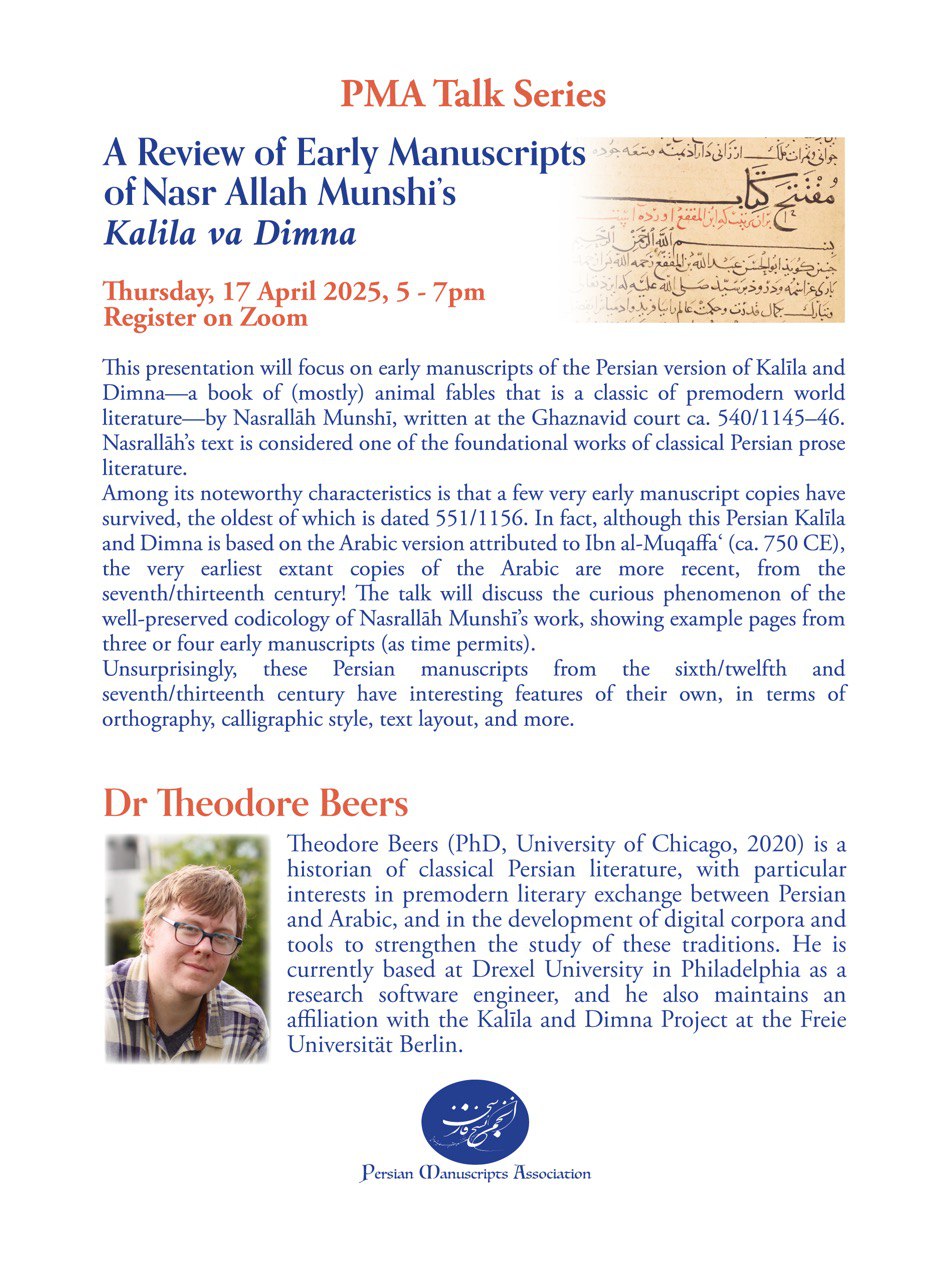
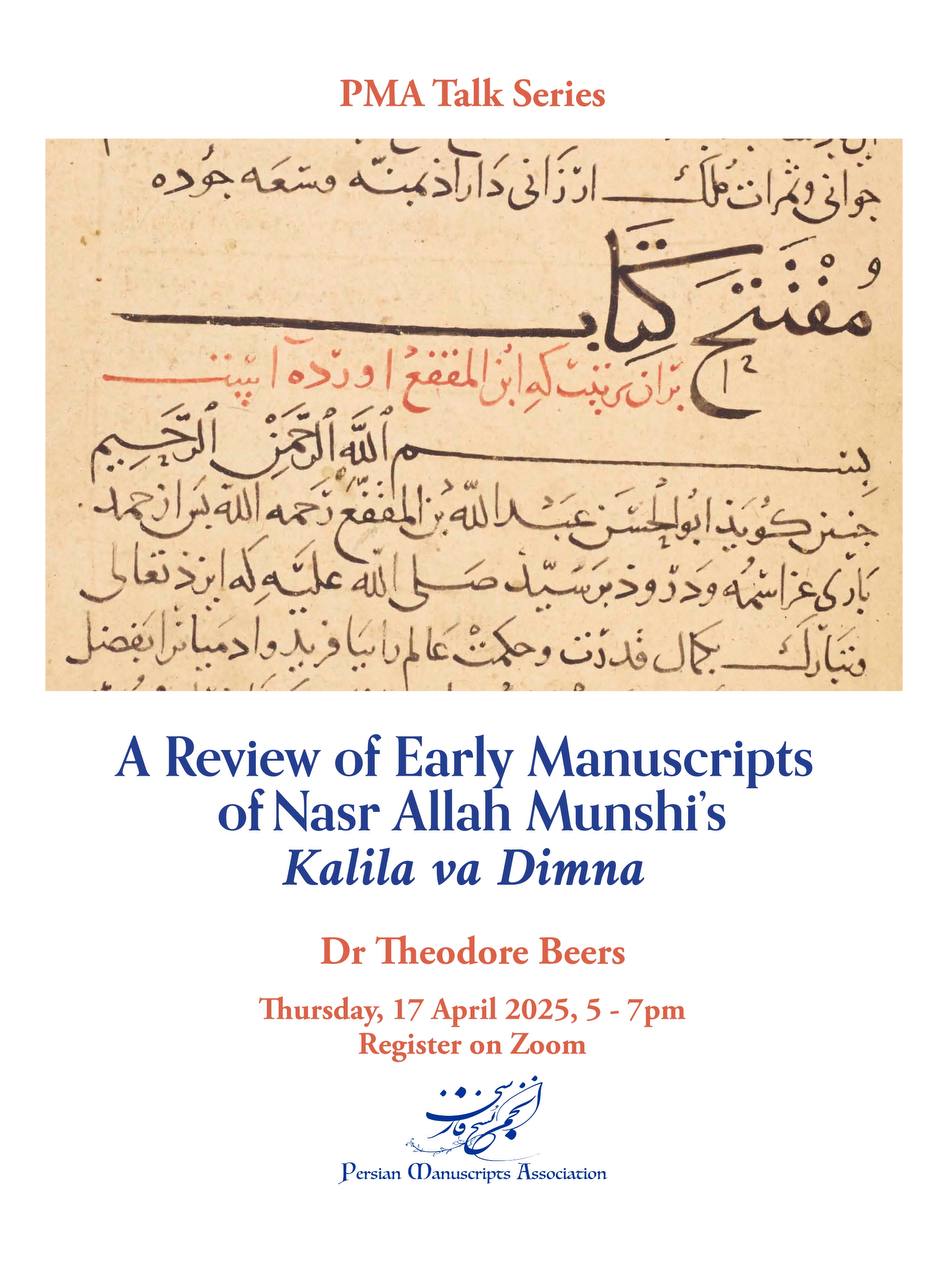
Among its noteworthy characteristics is that a few very early manuscript copies have survived, the oldest of which is dated 551/1156. In fact, although this Persian Kalila and Dimna is based on the Arabic version attributed to Ibn al-Muqaffaʿ (ca. 750 CE), the very earliest extant copies of the Arabic are more recent, from the seventh/thirteenth century! The talk will discuss the curious phenomenon of the well-preserved codicology of Nasrallāh Munshī’s work, showing example pages from three or four early manuscripts (as time permits).
Unsurprisingly, these Persian manuscripts from the sixth/twelfth and seventh/thirteenth century have interesting features of their own, in terms of orthography, calligraphic style, text layout, and more.
About the speaker
Theodore Beers (PhD, University of Chicago, 2020) is a historian of classical Persian literature, with particular interests in premodern literary exchange between Persian and Arabic, and in the development of digital corpora and tools to strengthen the study of these traditions. He is currently based at Drexel University in Philadelphia as a research software engineer, and he also maintains an affiliation with the Kalila and Dimna Project at the Freie Universität Berlin.